Drivers#
The drivers SESAME can build, their status, and the exact values each one ships with. Pick a driver with Which driver for my app?, then read the matching guide for setup.
Status#
| Driver | Status |
|---|---|
fake |
Now. Local development and tests only. Refuses to boot in production. |
cas |
Now. CAS 2.0 against Academica by default. |
gateway |
Now (built and tested). The recommended driver for apps on Citadel once Drawbridge is live: a signed JWT assertion from the auth gateway (on Citadel, that is auth.apps.wayne.edu, the first planned one), never a bare header. No Entra registration per app: Drawbridge holds it once. Drawbridge is released but has no production gateway yet, so a Citadel app uses cas today. |
saml |
Now, opt-in. A SAML 2.0 service provider for a Shibboleth-style IdP; signed assertions required. No default IdP: the app names the IdP's metadata. Needs onelogin/php-saml 4.3.2 or later. |
oauth2 |
Now. A JWT bearer token verified against the issuer's key set (JWKS), RS256 only. Microsoft Entra ID first. APIs only. |
oidc |
Now. Browser sign-in with OpenID Connect (code flow with PKCE), Microsoft Entra ID first. Needs its own Entra registration per app; for apps off Citadel and APIs. Needs league/oauth2-client. |
The factory#
DriverFactory::make() builds the driver named by the driver config value. Anything else throws InvalidConfig with Unknown driver "<name>".
public static function make(
    Config $config,
    ?ClientInterface $http = null,
    ?RequestFactoryInterface $requests = null,
    ?ClockInterface $clock = null,
    ?ReplayGuard $replayGuard = null,
    ?CacheInterface $jwksCache = null,
    ?SessionPort $session = null,
): Driver
| Argument | Driven by | What it does |
|---|---|---|
$http (PSR-18 client) |
cas, oauth2, oidc, saml (metadata URL only) |
Talks to the identity provider over HTTP. The factory cannot build an HTTP client itself, so the app passes one. |
$requests (PSR-17 request factory) |
cas, oauth2, oidc, saml (metadata URL only) |
Builds the HTTP requests the drivers send. |
$clock (PSR-20 clock) |
cas, gateway, oauth2 |
Supplies the sign-in time. Without one, those drivers use the system clock. |
$replayGuard (a ReplayGuard, for example a Psr16ReplayGuard over a PSR-16 cache) |
gateway, saml |
Remembers used assertion jti values (for saml, assertion IDs) so a captured assertion cannot be replayed. Fifth argument. Optional for saml, which builds a Psr16ReplayGuard over the sixth argument's cache without one. |
$jwksCache (PSR-16 cache) |
oauth2, oidc, saml |
Holds the fetched key set. Sixth argument. Required for oauth2; optional for oidc, which keeps the discovery document and the key set in process memory without one. Required for saml, which parks the IdP's response there, keeps fetched metadata and remembers used assertion IDs. |
$session (the app's SessionPort) |
cas, oidc, saml |
Holds the driver's pending sign-in (for oidc the state, nonce and PKCE verifier; for saml the AuthnRequest ID), bound to the browser. Seventh argument. |
When a required argument or config value is missing, the factory throws InvalidConfig:
| Missing | Message |
|---|---|
PSR-18 client for cas |
The cas driver needs a PSR-18 client. Pass $http to DriverFactory::make(). |
| PSR-17 request factory | The cas, oauth2 and oidc drivers need a PSR-17 request factory. Pass $requests to DriverFactory::make(). |
PSR-18 client for oauth2 |
The oauth2 driver needs a PSR-18 client to fetch the issuer's key set. Pass $http to DriverFactory::make(). |
PSR-16 cache for oauth2 |
The oauth2 driver needs a PSR-16 cache to hold the fetched key set. Pass $jwksCache to DriverFactory::make(). |
oidc config block |
The oidc driver needs the "oidc" config block. |
PSR-18 client for oidc |
The oidc driver needs a PSR-18 client for discovery, the key set and the token request. Pass $http to DriverFactory::make(). |
App session for oidc |
The oidc driver needs the app session to bind each sign-in to the browser. Pass $session to DriverFactory::make(). |
saml config block |
The saml driver needs the "saml" config block. |
App session for saml |
The saml driver needs the app session to bind each sign-in to the browser. Pass $session to DriverFactory::make(). |
PSR-16 cache for saml |
The saml driver needs a PSR-16 cache to park the IdP response and remember used assertions. Pass $jwksCache to DriverFactory::make(). |
Non-empty gateway.public_key, gateway.issuer or gateway.audience (and oauth2.issuer, oauth2.jwks_url, oauth2.audience) |
The config key "%s" must be a non-empty string. |
| Unknown driver | Unknown driver "%s". |
fake#
A driver for local development and tests only. It returns the identity it was built with, every time. It refuses to construct outside the allowed development environments: it throws, it never silently falls back. The check is an allowlist, so an environment that is not explicitly a development one (production, staging, or anything unknown) can never boot the fake driver.
| Value | Exact |
|---|---|
| Name | fake |
| Allowed environments | local, development, dev, testing, test (an allowlist, matched after lowercasing and trimming) |
| Identity | The username and attributes it was built with, every time |
| Outside the allowlist | Throws FakeDriverInProduction with The fake driver only runs in local, development and testing environments. |
logoutUrl(), serviceUrl() |
null |
The factory builds it from the fakeUsername and fakeAttributes config properties, with the username defaulting to the empty string.
cas#
CAS 2.0 against Academica by default.
- The service URL is the configured value only. This driver never reads
Host,X-Forwarded-Proto,X-Forwarded-Hostor any other request header to build it, which removes the wayne-cas proto trust and the phpCASX-Forwarded-Portbreak in one rule. - The default protocol is 2.0 because Academica is believed to redirect cookieless
/p3/serviceValidatecalls to the login page. Set the protocol to 3.0 (cas.protocol) when a CAS server does release attributes on/p3/serviceValidate. - Ticket replay: the CAS server refuses a reused ticket with
INVALID_TICKET. SESAME relies on that and surfaces it asAuthenticationFailed. - The sign-in time comes from the CAS
authenticationDateattribute when the server sends one; otherwise it is the driver's clock. Time is read through a PSR-20 clock, so the future-date guard is testable. - CAS carries no MFA signal of its own, so by default the identity carries no MFA facts and the MFA check fails closed. With
assume_mfaon, the driver trusts the CAS server's owner's word that a successful validation means MFA happened for the user's current SSO session: the identity'samrthen includesmfa, and its MFA time (authTime) is theauthenticationDatewhen the server sent one. The driver never invents anauthTime: with noauthenticationDate, the MFA time stays unset and the MFA check answersNO_AUTH_TIME.
| Value | Exact |
|---|---|
| Protocol | 2.0 by default; only 2.0 or 3.0 are accepted |
cas.base_url, cas.service_url |
Must be absolute https:// URLs; http://localhost and http://127.0.0.1 pass only when the environment is local (the fake driver's list) |
| Ticket | An ST- service ticket, at most 256 characters (^ST-[A-Za-z0-9._\-]{1,253}$) |
| Validation path | /serviceValidate for 2.0, /p3/serviceValidate for 3.0 |
| Login query | service= always; renew=true when renew is on |
| Logout URL | /logout?service=<return>&url=<return> (Academica reads url=; service= is the CAS-standard parameter name) |
The exact error messages:
| Condition | Message |
|---|---|
| Bad protocol | The config key "cas.protocol" must be "3.0" or "2.0", got "%s". |
| Bad URL | The config key "%s" must be an absolute https:// URL, got "%s". |
| Bad ticket | The ticket in the request is not a valid CAS ticket. |
gateway#
Signed JWT assertions from the Drawbridge gateway. "Open Sesame", but only the real magic word gets the door.
- The driver reads one configured header that holds a signed JWT, verifies its signature against the gateway's public key, and checks the issuer, audience and time claims.
- It never reads a plain identity header (
Remote-User,X-Remote-User, or any spelling of them), because a plain header can come from anywhere on the shared network. - The request must also come from a trusted proxy: the direct peer (
REMOTE_ADDR) must match one of the configured CIDR ranges. A valid assertion from an untrusted peer is still rejected. - The algorithm is pinned from config, so a token that claims a different algorithm (or
none) is refused before its signature is even looked at. - Every assertion is single-use. The gateway signs a fresh assertion for every request, so a captured one is only dangerous if it can be sent twice: the driver requires a
jticlaim, refuses assertions that live longer than the configured maximum, and hands thejtito aReplayGuard, which remembers it for the assertion's lifetime. A second use of the samejtiis a replay and is refused. - A token without an issue time or an expiry is not a usable assertion, and a token without a subject has no one to sign in. The subject becomes the username.
| Value | Exact |
|---|---|
| Assertion header | X-Sesame-Assertion by default (the factory's default when the config names none) |
| Max assertion lifetime | 300 seconds (the constructor default for maxLifetimeSeconds) |
| Replay guard | Required unless gateway.allow_without_replay_guard is on (local development only) |
| Required claims | A subject, an issue time and an expiry, plus the jti for the replay guard |
| Public keys | a single gateway.public_key, gateway.public_keys as a map of kid to key, or gateway.jwks_file, a JWKS file of the same keys read at boot |
| Choosing a key | the token's kid names the listed key; an unknown kid is refused, and so is a missing one when two or more keys are listed (one listed key verifies a token without a kid) |
| Key set file limits | at most 64 KB and 8 keys, public keys only, one kid each, the type gateway.algorithm needs |
The exact error messages:
| Condition | Message |
|---|---|
| No replay guard | The gateway driver needs a ReplayGuard so a captured assertion cannot be replayed. Pass one to the driver (or to DriverFactory::make()), or set gateway.allow_without_replay_guard to true for local development only. |
| Empty key map | The config key "gateway.public_keys" must be a non-empty map of kid to key. |
| Two key settings with a key set file | Set only one of "gateway.public_key", "gateway.public_keys" and "gateway.jwks_file": they are three ways to give the same keys. |
| Missing key set file | The gateway key set file named by "gateway.jwks_file" does not exist or cannot be read. |
| Private key material in the key set | The key "<kid>" in the gateway key set ("gateway.jwks_file") holds private key material. Publish only the public half, and treat that private key as exposed. |
oauth2#
JWT bearer tokens from an identity provider. "Open Sesame", where the magic word is a token only the issuer can sign.
- The driver reads the
Authorizationheader (a Bearer token, per RFC 6750), verifies its RS256 signature against a key from the issuer's JWKS, and checks the issuer, audience, time, scope and role claims. - It accepts only RS256:
noneand HMAC algorithms are refused before their signatures are even looked at, because an HMAC token signed with the public key is a classic forgery. - Microsoft Entra ID is the first planned issuer: point
issuer,jwks_urlandaudienceat the tenant's v2.0 endpoints and the app's client id, and the driver signs the user in from the access token. Any other RS256 issuer works with the same settings. - The username comes from one configurable claim:
preferred_usernameby default, oraccessid(the UPN's mail prefix) when the app wants that. - There is no redirect step and no logout on the provider side: the token arrives with the request, and signing out is the app's own session being dropped.
| Value | Exact |
|---|---|
| Token | A Bearer token in the Authorization header (RFC 6750) |
| Algorithm | RS256 only; none and HMAC are refused |
| Identity claim | preferred_username by default, or accessid |
| Key set | Fetched from jwks_url over HTTP and kept in the PSR-16 cache |
| Unknown key | AuthenticationFailed with No published signing key matches the access token (oauth2.unknown_key). |
oidc#
Browser sign-in with OpenID Connect, Microsoft Entra ID first. "Open Sesame" said to the right door, then checked at the counter. The driver runs the authorization code flow with PKCE (S256):
- A request without a code is the start. The driver makes a fresh
stateandnonce, hasleague/oauth2-clientbuild the authorization URL and the PKCE verifier, keeps all three in the app's session (bound to this browser, single use, expiring), and answers with aRedirectto the identity provider. - A request with a code (or an error) is the callback. The pending sign-in for its
stateis taken out of the session first, so a replayed callback finds nothing.league/oauth2-clientexchanges the code with the PKCE verifier and the client secret, and SESAME's own validator (the samefirebase/php-jwtandJwksProviderthe oauth2 driver uses) checks the ID token: signature on an RSA allowlist,iss,aud,azp,exp,nbf,iatand the nonce.
- The endpoints come from the issuer's discovery document, kept in a PSR-16 cache, unless config names them.
- No
promptand nomax_ageare sent by default, so an existing Entra session signs the user in without a click. - A start request with
step_up=1adds the app's configured step-up parameters (prompt=loginby default, and optionallymax_age,acr_valuesandclaims), and its callback then requires a freshauth_time. - The username comes from one configurable claim (
accessidby default). Falling back to the part ofpreferred_usernamebefore the@is an opt-in (oidc.username_fallback), because users can changepreferred_username. iss,sub,tidandoidare passed to the resolver, so apps can key accounts on issuer plussub, or tenant plusoid. The roles claim (wsu_rolesby default) becomes therolesattribute, the claims the app lists inoidc.claims(wsu_rolesandaccessidby default) are passed through under their own names, andauth_timeandamrbecome the identity's MFA facts with the same rules as the cas driver'sauthenticationDate: the driver never invents a sign-in time.- The access token and the ID token are never stored: the identity is all the session keeps.
- The driver needs
league/oauth2-client, which SESAME suggests but does not require. - The token request goes through Guzzle (via
league/oauth2-client). When the app's PSR-18 client is Guzzle, it is reused for that too, with redirects turned off on each token request; otherwise a Guzzle client is built that does not follow redirects and gives up after ten seconds. Discovery and the key set go through the PSR-18 client.
saml#
Browser sign-in as a SAML 2.0 service provider, opt-in, for a Shibboleth-style IdP. The same magic words, now with a schema. The driver stands on onelogin/php-saml (strict mode) and runs in three requests:
- A request to the login URL without
saml_handleis the start. The driver builds an AuthnRequest (HTTP-Redirect, signed when configured), keeps its ID in the app's session (single use, expiring), and answers with aRedirectto the IdP; a checkedreturn_torides along as the RelayState. - The IdP's POST to the ACS URL goes to
receive(), notlogin(). It carries no Lax session cookie, so the driver parks the raw Response in the PSR-16 cache under a single-use 256-bit handle, without touching the session, and answers with aRedirect(sent as 303) to the login URL withsaml_handle. - That GET is the finish. The parked Response and its pending request are taken (both single use), and php-saml checks the schema, the signature and what it covers, Destination and Recipient (against the configured ACS URL), Audience, Issuer, InResponseTo, the time conditions and the bearer subject confirmation. SESAME adds a required assertion signature, SHA-2 only, an IssueInstant within the leeway and the maximum age, and the replay guard on the assertion ID.
- IdP-initiated responses are refused; a sign-in must start at the app.
- The username comes from one mapped attribute (
accessid, fromuid, by default).email,name,affiliationsandeppnare mapped from the eduPerson and inetOrgPerson OIDs or their friendly names, andissuer,name_idandauthn_contextare passed too. AuthnInstantis the identity's sign-in time, never invented; anAuthnContextClassRefinsaml.mfa_contexts(the REFEDS MFA profile by default) addsmfaand is the identity's authentication context.step_up=1sendsForceAuthnand requires a freshAuthnInstant.- No single logout:
logoutUrl()returnsnull, so logout is local. metadata()returns the SP metadata, withWantAssertionsSigned="true".- The driver needs
onelogin/php-saml4.3.2 or later (and xmlseclibs 3.1.5 or later), which SESAME suggests but does not require. Older releases are refused at boot and bycomposer.json'sconflict.
Setup and every key: The saml driver.
What every driver returns#
Every driver exposes the same four methods: name(), login(), logoutUrl() and serviceUrl(). login() answers with a Redirect to the identity provider, or with an Authenticated step carrying an Identity (the username, the attributes, the driver name and the sign-in time). The fake driver's logoutUrl() and serviceUrl() return null; the cas driver's return the configured logout URL and service URL.
Walk around the shop#
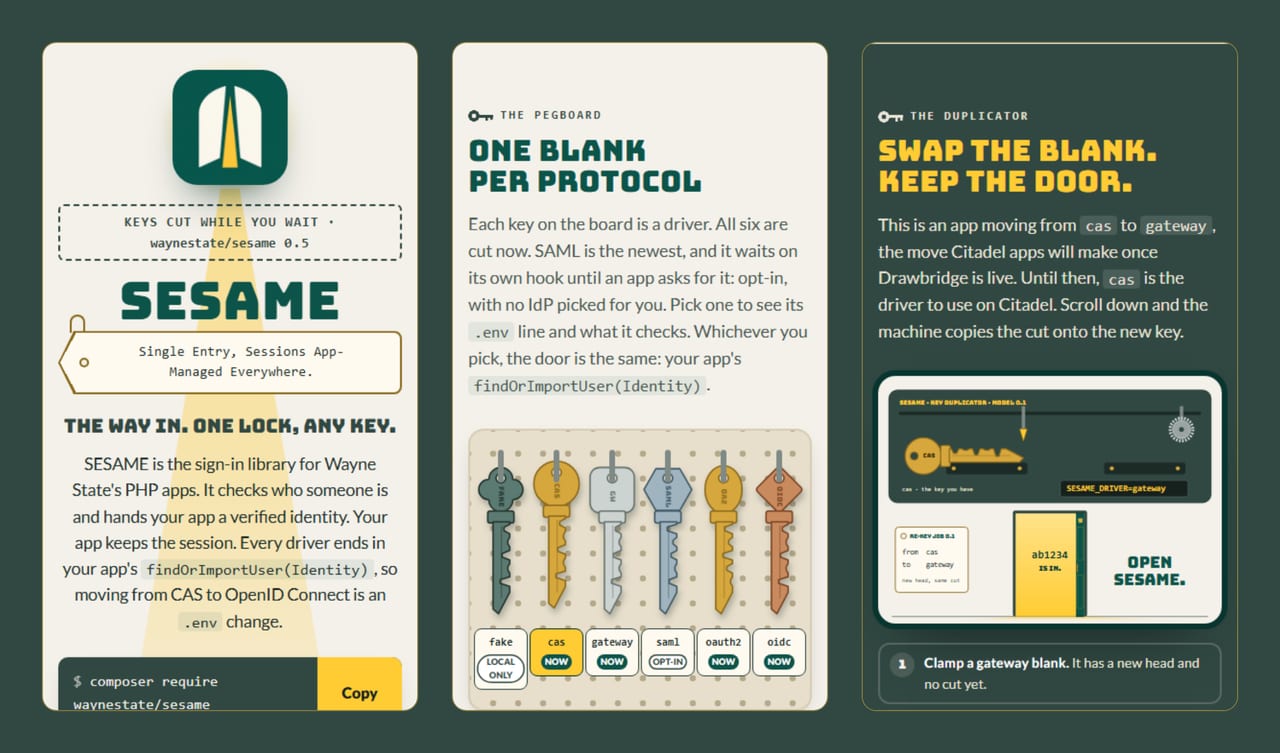
The front page's counter, pegboard and duplicator.